
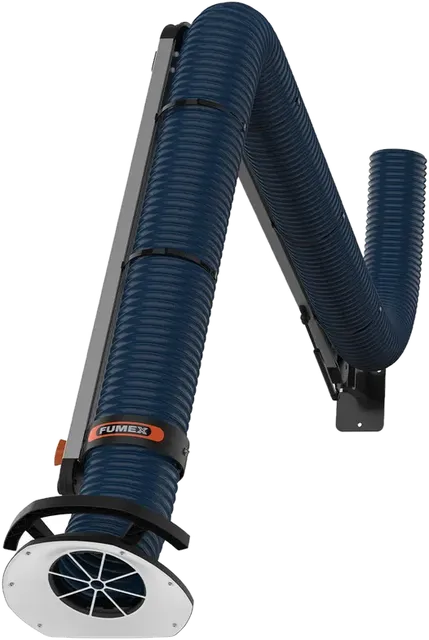
A welding fume extraction arm is a flexible Local Exhaust Ventilation (LEV) device that captures hazardous welding fume at source, before it reaches the welder’s breathing zone. It draws contaminated air through an adjustable hood positioned close to the welding arc, carries it through ducting to a filtration system, and removes the hazardous particles before the cleaned air is discharged or recirculated. Correct positioning of the hood is the single most important factor in how well an extraction arm performs.
Extraction arms are widely installed in fabrication workshops, manufacturing facilities and training centres because they deliver effective source capture while staying easy to position and adjust. This page explains how they work, how to position and size them, the mounting and retrofit options, which welding processes they suit, and how to keep them performing.
For the wider picture, see our fume extraction knowledge centre and our overview of the types of fume extraction available.
What is a welding fume extraction arm and how does it work?
An extraction arm is a flexible, adjustable LEV device designed to capture welding fume directly at the source. The principle is source capture using negative pressure: a fan pulls air through an adjustable hood placed near the welding arc, contaminated air travels along the arm’s ducting into a filtration system where hazardous particles are removed, and the cleaned air is then discharged or recirculated where appropriate.
The closer the hood sits to the welding process, the more effective the extraction becomes. Because the arm is repositionable, the operator can keep the hood intercepting the fume plume as the work moves.
Why should I use an extraction arm?
Extraction arms capture welding fume before it spreads through the workshop, improving air quality and reducing employee exposure to hazardous airborne particles. They are easy to reposition, suitable for a wide range of welding processes, and can often be installed without major changes to an existing workshop.
When correctly selected, positioned and maintained, an extraction arm is one of the most effective methods of controlling welding fume. Its performance depends on three things working together: adequate airflow, correct hood positioning, and regular maintenance.
How close should an extraction arm be to the weld?
The extraction hood should normally sit as close to the welding arc as is practical, without interfering with the work being carried out. Capture efficiency falls away rapidly with distance, so even a small increase in the gap between hood and arc can significantly reduce the amount of fume captured.
For this reason, operators should reposition the extraction arm throughout the welding operation rather than setting it once and leaving it. An arm placed too far away simply will not capture the fume effectively, no matter how well specified the rest of the system is.
Where should the extraction hood be positioned?
Position the hood so that welding fume naturally travels into the airflow before it reaches the welder’s face. Correct hood placement is often more important than simply increasing airflow. In most cases the hood should be set to intercept the fume plume before it reaches the welder’s breathing zone.
Whether the hood works best above or beside the weld depends on the application and the natural movement of the fume. The goal is to capture the plume while avoiding disruption to the shielding gas.
Can extraction affect shielding gas?
Yes. If the hood is positioned too close to the arc, or airflow is excessive, it can disturb the shielding gas and affect weld quality. Correct system design and considered hood positioning let you capture fume effectively without compromising the welding process, which is one reason professional LEV design matters.
What size and length of extraction arm do I need?
The correct arm size depends on the work area, the reach required and the workshop layout. An arm with sufficient reach lets operators position the hood correctly for every task without excessive stretching or repositioning, which in turn encourages consistent, correct use.
Length. Extraction arms come in a range of lengths to suit different applications. The best choice depends on the size of the welding bay, the dimensions of the fabrications being welded, and the operator’s working area. Choosing the right length improves usability and encourages consistent use.
Diameter. The diameter influences airflow capacity and overall system performance. It should be selected as part of the wider LEV design so that sufficient airflow reaches the hood. Because diameter, fan capacity and ducting all interact, professional advice helps ensure the system is correctly specified from the outset.
For guidance on matching all these factors to your workshop, see choosing a fume extraction system.
Can one extraction arm cover multiple welding bays?
It is possible in some situations, but using a single arm across multiple workstations often reduces efficiency and may discourage operators from repositioning the hood correctly for each weld. As a rule, dedicated extraction at each welding bay provides the most effective long-term solution and the greatest protection for every welder.
Should I choose wall-mounted or ceiling-mounted arms?
Both are common; the right choice depends on your workshop.
Wall-mounted arms are popular because they save floor space, are simple to install and offer excellent flexibility. They are particularly well suited to dedicated welding bays.
Ceiling-mounted arms are ideal where wall space is limited, or where large fabrications need unrestricted access around the welding area. They also help keep walkways clear and reduce trip hazards.
Can extraction arms be retrofitted to an existing workshop?
Yes. Most existing workshops can be upgraded with extraction arms without major structural alterations, which makes retrofitting a practical way to introduce effective source capture. The most suitable retrofit depends on your existing building and welding processes, and Extractability can advise on the right solution for your site.
If you are weighing fixed arms against portable options, our guide to mobile fume extraction units compares the two approaches.
Are extraction arms suitable for my welding process?
Extraction arms suit a broad range of processes:
- MIG welding: widely used with extraction arms, which provide effective source capture while keeping good access to the workpiece. MIG produces relatively high fume levels, so correct positioning is essential.
- TIG welding: although TIG produces less visible fume, hazardous airborne contaminants are still generated, so extraction arms remain effective. They are especially worthwhile when welding stainless steel or carrying out prolonged production work.
- MMA welding: MMA produces relatively high fume levels from the electrode coating, making extraction arms an effective way to reduce exposure. The hood should be repositioned regularly as welding progresses.
- Laser welding: many laser applications benefit from source-capture extraction using suitably designed systems. The exact solution depends on the laser equipment, materials and production process.
How do I maintain an extraction arm?
Regular maintenance includes checking airflow, inspecting joints and seals, ensuring the arm moves freely, and confirming the hood stays securely positioned. Routine maintenance maximises extraction performance and extends equipment life. Arms should be visually inspected regularly and included within planned LEV servicing schedules. Checking for damage, loose joints and reduced airflow helps catch problems before performance suffers.
Why won’t my extraction arm stay in position?
If an arm drifts or drops during use, the internal friction joints or support mechanisms usually need adjustment or maintenance. A correctly balanced arm stays where it is put, which encourages operators to position it properly and improves fume capture.
Why isn’t my extraction arm capturing the fume?
Poor capture is most often caused by incorrect hood positioning, insufficient airflow, blocked filters or damaged ducting. Before reaching to increase airflow, check that the hood is positioned correctly and that the system has been properly maintained. Maintenance and inspection also underpin compliance; see our notes on LEV testing and compliance.
Why choose a Fumex extraction arm from Extractability?
Extractability supplies the Fumex range of extraction arms, designed to provide effective source capture across a wide variety of welding applications. Whether you are equipping a single welding bay or specifying extraction for an entire fabrication facility, we can recommend the most appropriate arm based on your workshop layout, welding process and operational requirements.
By combining quality Fumex equipment with practical technical advice, Extractability helps businesses improve workplace air quality while supporting compliance with current HSE guidance. Talk to our team about the right arm, and the right LEV design, for your workshop.